
So you just finished your degree. Congratulations. Now comes the part nobody really prepares you for in university — figuring out how the government job system in Pakistan actually works and how to get into it.
Because here is the truth: the system is not complicated once you understand it. But if nobody explains it to you, it feels like a maze with no map. Which recruiting body handles which jobs? What documents do you need? How do you register? What tests will you have to give? What happens after you pass the test?
This guide answers all of that in plain language. By the end of it you will know exactly what to do next — whether you want a federal government job, a provincial posting in Punjab, Sindh, KPK, or Balochistan, or a position at a public sector university or autonomous body.
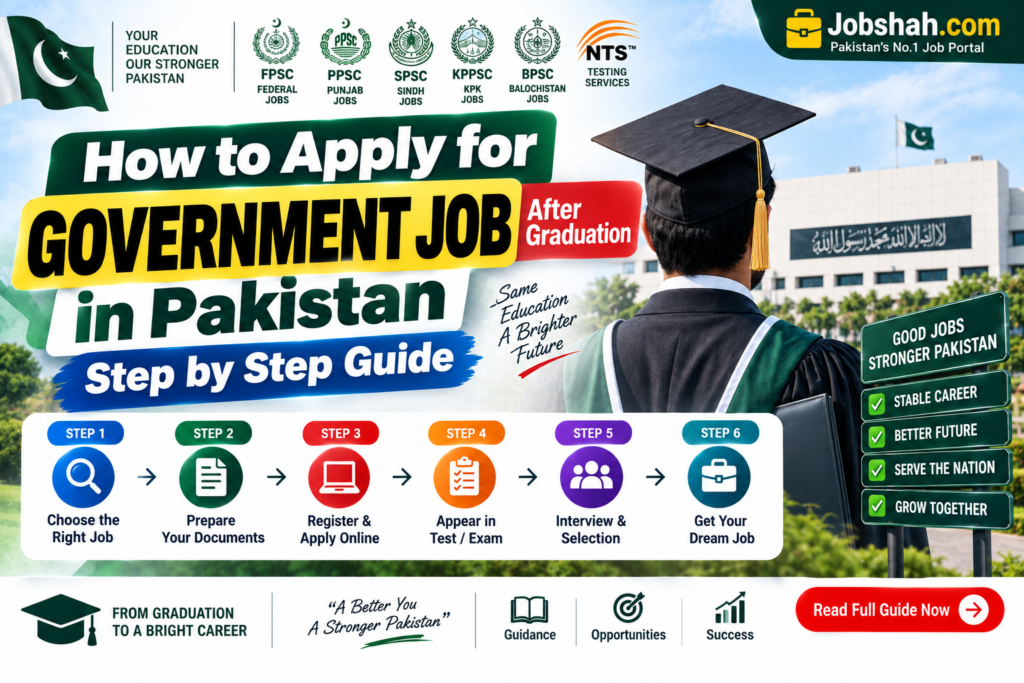
First — Understand How Government Recruitment Works in Pakistan
The government does not hire directly through one single window. Different types of jobs are handled by different recruiting bodies. Understanding this is the most important thing a fresh graduate needs to know.
Here is the basic structure:
Federal Government Jobs are handled by the Federal Public Service Commission (FPSC). These are jobs in federal ministries, federal agencies, attached departments, and autonomous federal bodies.
Provincial Government Jobs are handled by each province’s own Public Service Commission:
- Punjab: Punjab Public Service Commission (PPSC)
- Sindh: Sindh Public Service Commission (SPSC)
- Khyber Pakhtunkhwa: Khyber Pakhtunkhwa Public Service Commission (KPPSC)
- Balochistan: Balochistan Public Service Commission (BPSC)
Testing Services like NTS (National Testing Service) conduct tests on behalf of many government organizations, universities, and autonomous bodies that do not recruit through a formal public service commission.
Autonomous Bodies and Corporations — organizations like NADRA, ERRA, PTA, OGDCL, WAPDA, and public sector universities — often recruit independently through their own HR departments, advertising vacancies in newspapers and on their official websites.
CSS (Central Superior Services) is Pakistan’s elite civil service competitive examination conducted by FPSC for BPS-17 positions in the federal bureaucracy. This is a separate track from general government recruitment and requires a separate strategy.
Knowing which category your target job falls into tells you exactly where to look and how to apply.
Step 1 — Figure Out What Kind of Government Job You Want
Before you start applying for everything you see, spend one hour thinking about what you actually want. Government jobs in Pakistan span an enormous range — from office clerks to engineers, from medical officers to economists, from forest rangers to district officers.
Ask yourself these questions:
What is your degree? This matters more in government hiring than almost anywhere else. A Bachelor’s in Computer Science opens different doors than a Bachelor’s in Public Administration or an MBBS. Know which departments and positions your degree qualifies you for.
Which BPS grade are you eligible for? With a 16-year Bachelor’s degree, you are typically eligible for BPS-14 to BPS-17 depending on the post. For BPS-17, most positions require a competitive exam (FPSC, PPSC, CSS, PMS). For BPS-14 to 16, departmental tests are more common.
Federal or provincial? Federal jobs through FPSC have national eligibility. Provincial jobs through PPSC, SPSC, etc. usually require domicile from that province.
Technical or general? If you have a technical degree (engineering, medicine, computer science), there are specialized cadres and departments where your qualification gives you a direct advantage.
Getting clear on this before you start applying saves you months of misdirected effort.
Step 2 — Get Your Documents Ready Before You Apply
This is the step most fresh graduates skip until the last minute. Do not make that mistake. Government job applications require a consistent set of documents and you need them ready — not “I will get them when I need them.”
Here is the core document set every fresh graduate needs:
| Document | Purpose | Where to Get It |
|---|---|---|
| CNIC | Identity verification | NADRA office or app |
| Domicile Certificate | Proves your residential district | DC Office of your district |
| Matric Certificate | Educational qualification | Your school / board |
| Intermediate Certificate | Educational qualification | Your college / BISE |
| Bachelor’s Degree | Educational qualification | Your university |
| Transcripts / DMCs | Detailed marks | Your university registrar |
| Character Certificate | Character verification | Gazetted officer or police |
| Passport-size Photographs | Application forms | Any photo studio |
| HEC Degree Attestation | Verifies your degree | HEC office or online |
HEC attestation is particularly important for government job applications. Many departments will not accept a degree that has not been attested by the Higher Education Commission. Apply for HEC attestation as soon as you receive your original degree — it can take 2 to 4 weeks.
For domicile, you must apply at your district’s DC office (Deputy Commissioner) in person. If you do not have a domicile certificate yet, get one now — before any application deadline is near.
Step 3 — Register on Official Government Job Portals
The government has multiple online portals where jobs are posted and applications are submitted. As a fresh graduate, you should be registered on all of them before you even start applying.
FPSC — Federal Public Service Commission
Website: fpsc.gov.pk
Register here for all federal government job applications. When FPSC advertises a vacancy, you apply through their portal. FPSC also conducts the CSS examination — if you want to pursue the civil service officer track, this is where that journey starts.
PPSC — Punjab Public Service Commission
Website: ppsc.gop.pk
For all Punjab government jobs — teachers, engineers, officers, managers in Punjab departments. Punjab-domicile holders apply here for provincial positions.
SPSC — Sindh Public Service Commission
Website: spsc.gov.pk
For Sindh government positions — Sindh domicile required for most posts.
KPPSC — KPK Public Service Commission
Website: kppsc.gov.pk
For KPK government positions.
BPSC — Balochistan Public Service Commission
Website: bpsc.gop.pk
For Balochistan government positions.
NTS — National Testing Service
Website: nts.org.pk
NTS conducts tests on behalf of hundreds of government organizations, universities, and corporations. Many jobs advertised in newspapers require NTS registration to apply. Register early and keep your NTS profile updated.
NJP — National Job Portal
Website: njp.gov.pk
The federal government’s unified job portal. Many departments post vacancies here directly. Create a profile and set up job alerts.
Action: Register on all these portals in one sitting. Save your login credentials somewhere safe. Keep your profile updated with your latest education and contact information.
Step 4 — Find Government Job Advertisements
Now that you are registered, here is where to actually find government job announcements:
Newspapers — Still the Primary Source
Despite everything moving online, government job advertisements in Pakistan are still legally required to be published in major newspapers. The newspapers to follow for government jobs are:
- Daily Jang — the highest volume of government job ads
- Daily Dawn — federal and professional positions
- Daily Dunya — Punjab government jobs
- Daily Express — general government jobs
- Daily Mashriq — KPK government jobs
- Daily Kawish — Sindh government jobs
Most of these now have digital editions and job sections online.
Job Portals and Websites
- Jobshah.com — updated daily with latest government vacancies
- rozee.pk — also covers government jobs alongside private sector
- mustakbil.com — Pakistan job listings
- Official websites of organizations you want to work for
Social Media and Alerts
Follow FPSC, PPSC, and major recruiting organizations on Twitter/X, Facebook, and LinkedIn. Many announcements appear on social media before or alongside newspaper publication. Set up Google Alerts for “government jobs Pakistan 2026” or your specific city.
Step 5 — Understand the Government Job Application Process
Once you find a job you want to apply for, here is the typical process:
Stage 1 — Read the Advertisement Carefully
Before doing anything else, read the advertisement from start to finish. Note:
- Exact eligibility criteria (education, age, domicile)
- Number of posts and which province/region they are for
- Application method (online, postal, walk-in)
- Application fee and payment method
- Required documents
- Last date
Missing any detail here is how people waste their own time applying for jobs they are not eligible for.
Stage 2 — Pay the Application Fee
Almost all government job applications have a fee — typically Rs. 200 to Rs. 2,000 depending on the post and organization. This is usually paid via:
- Bank challan (deposited at a designated bank)
- Online payment through 1Link, JazzCash, Easypaisa, or internet banking
- Pay Order or Demand Draft in favour of the recruiting organization
Keep the original fee payment receipt — you will need it with your application.
Stage 3 — Submit the Application
Depending on the advertisement, applications are submitted:
- Online through the recruiting body’s portal (FPSC, PPSC, NTS etc.)
- By post / courier to the specified address with attested documents
- Walk-in for some organizations with direct submission to HR
For online applications: fill every field accurately. For postal applications: use registered post or a reliable courier so you have a tracking number.
Stage 4 — Written Test
Most government jobs require a written test. For FPSC and PPSC, this is an MCQ-based computer or paper test covering:
- General Knowledge
- Pakistan Affairs
- Islamic Studies
- English
- Mathematics / Analytical reasoning
- Subject-specific questions (depending on the post)
You typically have 4 to 8 weeks between application and test date. Use that time to prepare. Practice MCQs daily — your FPSC/NTS test score is the single biggest factor in shortlisting.
Stage 5 — Interview / Viva Voce
Candidates who pass the written test are called for an interview or viva voce conducted by the commission or department. For FPSC general recruitment, the interview typically carries 15-20 marks. For CSS, the viva voce carries 300 out of 1200 marks.
Stage 6 — Medical Examination
After the interview, selected candidates are sent for a medical examination by a government Medical Board. You must be declared medically fit before a formal appointment letter is issued.
Stage 7 — Appointment and Verification
The final appointment order is issued after successful medical clearance and background verification. Verification includes checking your educational documents, domicile, and character certificate.
Step 6 — CSS vs Regular Government Jobs — Which Path Is Right for You?
This is the question most ambitious fresh graduates ask. Let me give you an honest answer.
Regular Government Jobs (FPSC / PPSC General Recruitment)
These are advertised regularly throughout the year. You apply for a specific post in a specific department — Assistant Director, Lecturer, Engineer, Medical Officer, etc. The test is focused on that post’s requirements. Competition is high but manageable with preparation. Joining BPS-17 through this route is realistic within 1-3 years of graduation.
CSS — Central Superior Services
CSS is Pakistan’s most prestigious and most competitive civil service examination. It qualifies you for positions in the elite All Pakistan Unified Grades (APUG) cadres — District Management Group, Police Service, Foreign Service, Inland Revenue, and others.
The CSS examination has an approximate pass rate of 2-3% — meaning 97 out of every 100 candidates fail. It requires 12 compulsory and optional subjects, a written examination spanning several days, and a Central Selection Board interview.
CSS is worth pursuing if you have the intellectual capacity and discipline for sustained, long-term preparation. But do not put your entire career on hold waiting for CSS. Many people spend 3-5 years trying for CSS and end up with neither CSS nor any other government job. The smart strategy is: prepare for CSS while also applying for regular FPSC/PPSC positions simultaneously. That way you build your career regardless of CSS outcome.
Which Government Jobs Are Best for Fresh Graduates in 2026?
Based on what consistently gets advertised and where fresh graduates have the most realistic chance:
| Job Type | Recruiting Body | BPS | Best Degree |
|---|---|---|---|
| Assistant (BPS-15/16) | FPSC / Departments | 15-16 | Any Bachelor’s |
| UDC / Junior Clerk | Various | 9-11 | Intermediate to Bachelor |
| Lecturer (College) | PPSC / KPPSC | 17 | Master’s / MPhil |
| Assistant Director | FPSC / PPSC | 17 | Any Bachelor’s |
| Sub Inspector Police | Provincial Police | 14 | Bachelor’s |
| Engineer (Civil/Electrical/Mech) | FPSC / Departments | 17 | BE / BS Engineering |
| Medical Officer | FPSC / Departments | 17 | MBBS |
| Data Entry Operator | Various | 9-14 | Matric to Bachelor + typing |
| Computer Operator | Various | 12-14 | Bachelor’s CS/IT |
| Patwari | Board of Revenue | 9 | Matric to Bachelor |
| Income Tax Officer | FBR | 17 | Any Bachelor’s |
Common Mistakes Fresh Graduates Make When Applying
Applying without reading the eligibility criteria. If the ad says Punjab domicile only and you have Sindh domicile, you are not eligible. Read before applying.
Missing the last date. Government last dates are firm. Late applications are returned or discarded. Set calendar reminders for every deadline.
Submitting incomplete documents. Missing an attested copy, a wrong-size photograph, or a missing bank challan can get your application rejected without you knowing.
Not preparing for the written test. A lot of graduates apply and then do nothing until the test date. The candidates who pass are the ones who practice 50+ MCQs every day for the weeks between application and test.
Only targeting BPS-17. There is nothing wrong with starting at BPS-14 or 15 and working your way up. Departmental promotion is real and many senior officers started as clerks. Do not let status concerns stop you from building a stable government career at any level.
Final Thoughts
Getting a government job in Pakistan after graduation is completely achievable — but it requires a clear strategy, not random applications. Know which recruiting body handles your target role, get your documents in order before you need them, register on all major portals, follow the newspapers and Jobshah.com daily for new announcements, and start preparing for written tests immediately.
The competition is real but so is the opportunity. Every government exam cycle, thousands of fresh graduates get their first government posting. With the right preparation and a consistent approach, you can be one of them.
Frequently Asked Questions
1. How do I apply for a government job after graduation in Pakistan?
Register on the relevant recruiting body’s portal — FPSC at fpsc.gov.pk for federal jobs, PPSC at ppsc.gop.pk for Punjab, SPSC at spsc.gov.pk for Sindh, KPPSC at kppsc.gov.pk for KPK. Follow newspaper job sections and Jobshah.com daily. When you find a matching vacancy, pay the fee, submit your application with attested documents, and prepare for the written test.
2. Which government body handles federal jobs for fresh graduates?
The Federal Public Service Commission (FPSC) at fpsc.gov.pk handles most federal government jobs. NTS conducts tests for many autonomous bodies and universities. CSS is conducted separately by FPSC for elite civil service positions.
3. What documents are needed to apply for a government job in Pakistan?
CNIC, domicile certificate, Matric certificate, Intermediate certificate, Bachelor’s degree with HEC attestation, transcripts, character certificate, and passport-size photographs. Attested copies of all documents are required for most applications.
4. Is CSS the only way to get a BPS-17 government job?
No. FPSC and provincial PSCs regularly advertise BPS-17 positions — Assistant Director, Lecturer, Medical Officer, Engineer — through regular competitive exams. CSS is for the elite APUG cadres only. Most BPS-17 government officers did not go through CSS.
5. How long does it take to get a government job after applying?
The typical timeline from advertisement to appointment is 6 to 18 months — covering application, written test, interview, medical, and verification. Apply early and keep applying to multiple positions simultaneously rather than waiting for one result before applying again.
Related Blogs
- National Bank of Pakistan Jobs 2026 – NBP Latest Vacancies, Salary and How to Apply
- Pakistan Railways Jobs 2026 – Latest Vacancies, How to Apply and Complete Guide

- Bank of Punjab Jobs 2026 – Latest BOP Vacancies, How to Apply and Complete Guide
- NADRA Jobs 2026 – Latest Vacancies, How to Apply and Complete Guide

- Millat Tractors Internship 2026 – How to Apply, Departments, Stipend and Everything You Need to Know

I am a digital content writer and web publishing enthusiast specializing in jobs and career information in Pakistan. I research and publish accurate, useful, and easy-to-understand job updates to help job seekers find the right opportunities.