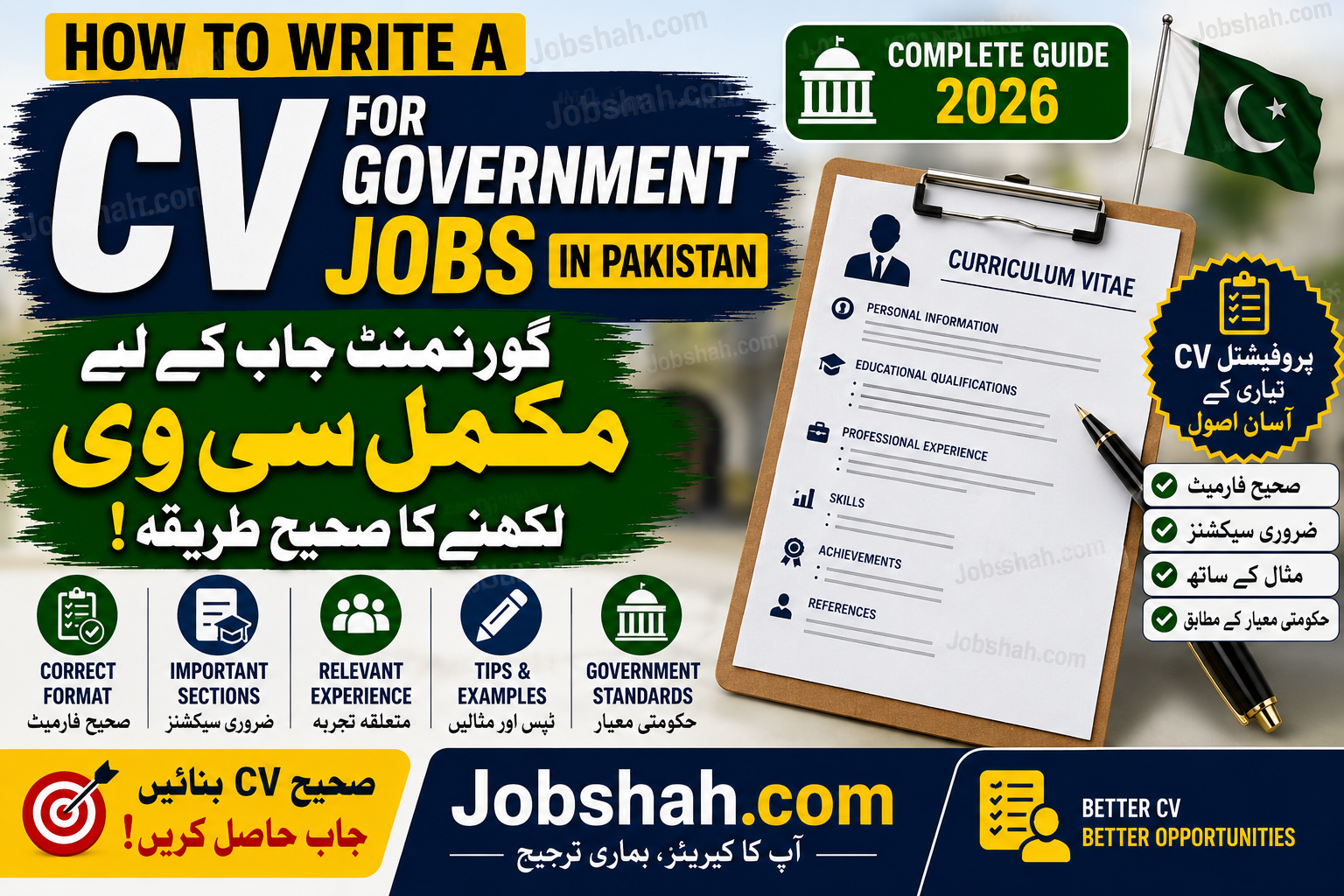
Let me be honest with you about something. Most people applying for government jobs in Pakistan send the same generic CV they use for private sector jobs — and then wonder why they never get called. A CV for a government job is a completely different document. It has a specific structure, specific expectations, and if you get it wrong, your application goes in the bin no matter how qualified you are.
I am going to walk you through exactly how to write a CV for government jobs in Pakistan — what to include, what to leave out, how to format it, and the small details that actually make a difference. By the end of this, you will have everything you need to put together a strong, professional CV that meets government hiring standards.
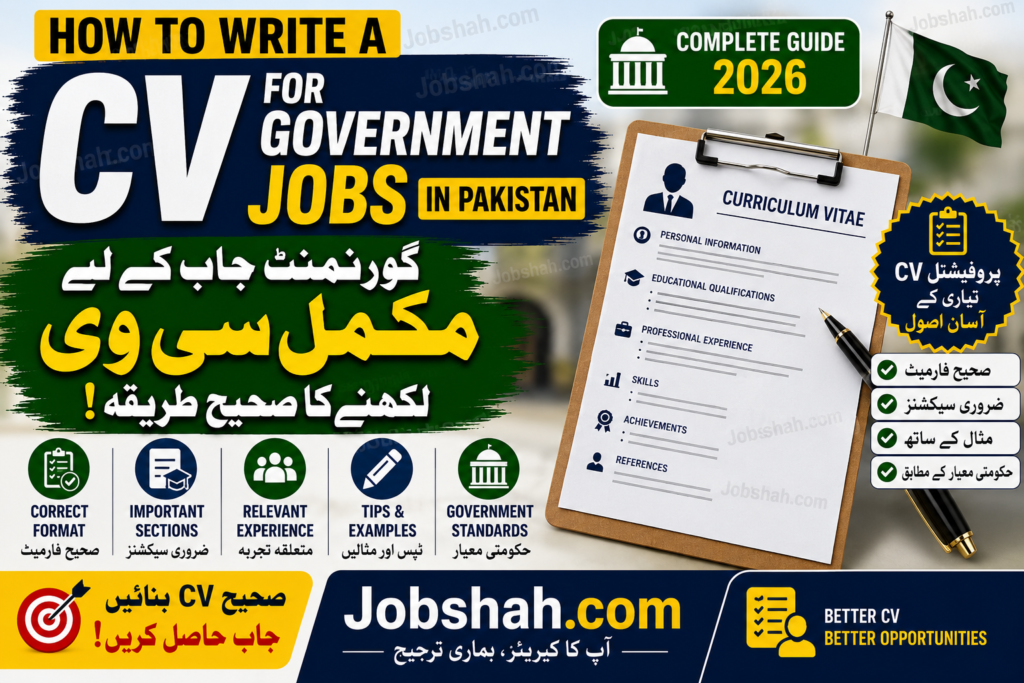
First, Understand What Government Recruiters Are Looking For
Before you write a single word, you need to understand the mindset of the person reading your CV.
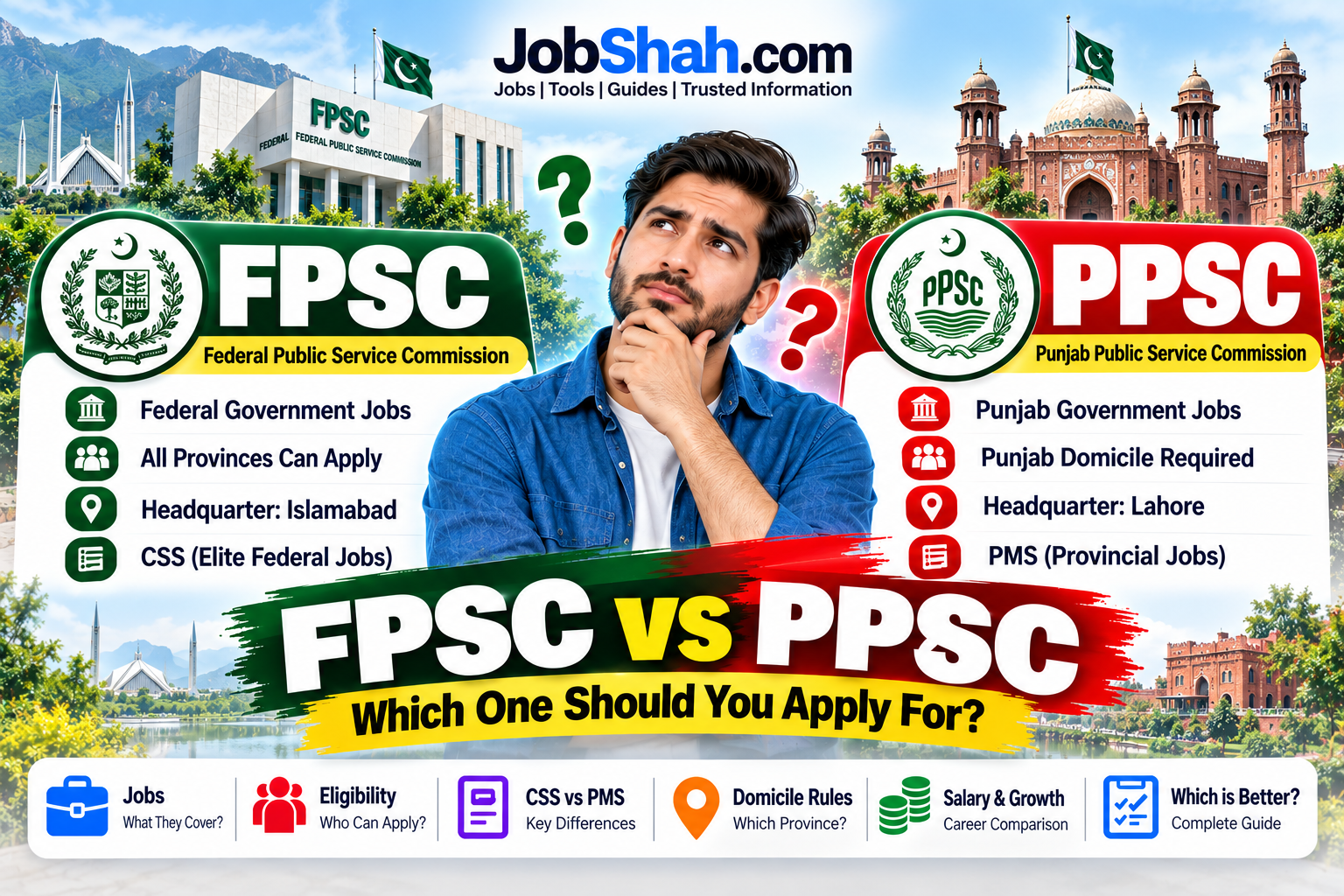
Government job applications in Pakistan — whether it is FPSC, PPSC, SPSC, BPSC, NTS, or a direct departmental posting — are evaluated by HR officials who go through hundreds of applications. They are not looking for creativity. They are not impressed by fancy fonts or colourful design. What they want to see is:
- That you meet the exact eligibility criteria stated in the advertisement
- That your qualifications are clearly presented and verifiable
- That your experience is relevant and documented
- That your personal details match your CNIC and supporting documents
That is it. Keep this in mind the entire time you are writing your CV.
What Is the Difference Between a CV and a Government Job Application Form?
This is a question a lot of people ask, and it is a fair one.
Most government jobs in Pakistan require you to fill out a prescribed application form — either downloaded from the recruiting body’s website or collected from their office. So why do you need a CV at all?
Here is the thing: many government organizations, especially those advertising in newspapers for management or professional-level posts, ask for a CV along with the application form. Even when they do not specifically ask for one, attaching a well-structured CV with your application package makes you look organized and professional — and it gives the reviewer a quick summary of your profile before they dig into your documents.
For FPSC, federal government ministries, autonomous bodies, public sector universities, and development sector organizations, a CV is almost always either required or expected.
Also Check > How to Get Domicile Certificate in Hyderabad Sindh – Complete Guide 2026
What to Include in a Government Job CV in Pakistan
Here is the structure that works. Do not over-complicate it.
1. Personal Information
Start with your full name at the top — bold, slightly larger than the rest of the text. Below that, include:
- Father’s name — always required in government applications
- Date of birth — must match your CNIC exactly
- CNIC number
- Domicile — mention your province and district clearly
- Religion
- Nationality — Pakistani
- Contact number — one active mobile number
- Email address — use a professional one (firstname.lastname@gmail.com)
- Postal address — your current mailing address
- Permanent address — if different from current
A lot of people skip the father’s name, domicile, and CNIC on their CV because they think it is old-fashioned. Do not skip these. Government HR officers expect them, and missing them makes your application look incomplete.
2. Objective or Profile Statement (Optional but Useful)
Keep this short — two or three sentences maximum. Do not write something vague like “seeking a challenging position to utilize my skills.” That tells nobody anything.
Instead, write something specific like:
“Mechanical engineer with 5 years of experience in government infrastructure projects, seeking the position of Assistant Engineer (Civil) at XYZ department. Domicile holder of Punjab with PPSC eligibility.”
Specific. Clear. To the point.
3. Educational Qualifications
This is the most important section for government jobs. Present your education in reverse chronological order — most recent degree first. For each qualification, include:
- Degree title (e.g., BS Computer Science, MBA Finance, Matric Science)
- Institution name
- Board or University
- Year of passing
- Grade / Division / CGPA / Percentage
Always mention the year of passing clearly. If you have a professional certification relevant to the post — like ACCA, CAMS, PMP, or a trade certificate — include it here too.
Do not write “awaiting result” unless the advertisement specifically allows applying with a pending degree. Most government job ads require the degree to be completed before the application deadline.
4. Professional Experience
List your work experience in reverse chronological order — most recent job first. For each position, write:
- Job title
- Organization name
- Duration (month/year to month/year)
- Key responsibilities — three to five bullet points
For government jobs, experience in government or semi-government organizations is weighted more heavily than private sector experience. If you have both, list government experience first or make it more prominent.
One thing that trips people up: when government ads say “experience in Grade 17 equivalent or above,” they mean you need to have worked in a position comparable to a Grade 17 officer. If you have worked in the private sector, you need to demonstrate that your role was equivalent in responsibilities and seniority. Be specific about this in your CV.
5. Skills
Keep this section practical and brief. For most government jobs, relevant skills include:
- Computer literacy (MS Office, typing speed if applicable)
- Shorthand speed (for Stenotypist posts)
- Typing speed in words per minute (for data entry or LDC posts)
- Knowledge of specific software relevant to the post
- Language proficiency (English, Urdu, regional languages if relevant)
- Driving license (for driver posts or field-based roles)
Avoid listing vague soft skills like “team player” or “good communicator” on a government CV. These take up space without adding value.
6. Additional Information
This short section can include:
- Publications (if applying for academic or research roles)
- Training courses attended
- Workshops or seminars (government-organized ones carry more weight)
- Professional memberships (PEC, PMDC, bar council, etc.)
If you are a registered professional — a Pakistan Engineering Council (PEC) registered engineer, a PMDC registered doctor, a PBC enrolled lawyer — this should be prominently mentioned, with your registration number.
7. References
Always include two references. For government jobs, references should ideally be:
- A current or retired government officer (Grade 17 or above)
- A gazetted officer who knows you professionally
- A senior academic (for academic positions)
Include their full name, designation, organization, and contact number. Make sure you have spoken to them before listing them — nothing looks worse than a reference who does not know you or was not informed.
How Long Should a Government Job CV Be?
Two to three pages. That is the sweet spot.
One page is too short — it suggests you have not provided enough information. Four or five pages is too long — busy HR officers will not read everything. Two to three pages gives you enough room to cover all sections properly without padding.
Formatting Rules That Actually Matter
You do not need to be a designer to format a good CV. Here is what matters:
Font: Use Times New Roman, Arial, or Calibri. Size 11 or 12 for body text. Size 14 for your name at the top.
Margins: Keep margins at 1 inch on all sides. Do not squeeze content by reducing margins — it makes the document look cramped.
Alignment: Use justified text alignment for a clean, professional look.
Headings: Use bold for section headings. Keep them consistent.
Colour: Black text on white background only. No colours, no background shading, no decorative elements.
Tables: Some people use tables to present qualifications. This is fine and actually makes the education section cleaner and easier to read.
File format: Save and submit as a PDF unless the employer specifically asks for a Word document. PDFs preserve your formatting across all devices and printers.
Print: If you are submitting a physical copy, print on A4 white paper. Do not use coloured paper.
Common Mistakes That Get Government CVs Rejected
Let me go through the most common ones because these are avoidable.
Mismatched information. If your CV says you graduated in 2018 but your degree certificate says 2019, that is a problem. Every date, name, and qualification on your CV must match your original documents exactly.
Missing CNIC or domicile details. In government applications, these are mandatory fields. Missing them makes your application look sloppy.
Lying about experience. This one is serious. Government organizations verify experience certificates. If you claim five years of experience but your documents only support three, you can be disqualified or even blacklisted.
Using a fancy design template. The government recruiter is not impressed by a two-column CV with your photo in a circle and coloured progress bars for your skills. Keep it plain and professional.
Attaching the wrong size photograph. Most government applications specify a passport-size photograph (35mm × 45mm) with a white or blue background. Use the right size and the right background.
Not tailoring the CV to the post. If the job advertisement asks for experience in financial management, your CV should clearly highlight your financial management experience — not bury it three bullet points down under a general “responsibilities” list.
Spelling and grammar errors. Read your CV three times before submitting. Then ask someone else to read it. One spelling mistake in a government CV can leave a very bad impression on the reviewer.
The Cover Letter – Do You Need One?
For most government jobs in Pakistan, a formal cover letter is not required. However, if you are applying for a senior management position, an academic role, or a post at an international organization or development sector body (like UN agencies, ADB, or World Bank projects), a cover letter is expected.
If you write one, keep it to one page. Address it to the specific person or designation mentioned in the advertisement. Mention the post you are applying for, why you are qualified, and your availability for interview. Do not repeat your entire CV in the cover letter.
Attested Copies — The Part Everyone Forgets Until the Last Day
Your CV is only one part of the application package. Most government jobs require you to submit attested copies of:
- CNIC (front and back)
- All educational degrees and certificates
- Transcripts and mark sheets
- Experience certificates
- Domicile certificate
- Any professional registration certificates (PEC, PMDC, etc.)
- Recent passport-size photographs (usually two)
All photocopies must be attested by a gazetted officer. This means an officer in BPS-17 or above signs and stamps each copy confirming it is a true copy of the original. You cannot self-attest government job documents.
Get your attestations done before the deadline — not on the last day. Finding a gazetted officer to attest documents on the same day as your submission deadline is stressful and unnecessary.
Online Applications vs Physical Applications
More and more government organizations are moving to online portals. FPSC, NTS, PPSC, and many others now require online submission through their websites, and you upload scanned copies of your documents rather than posting physical copies.
For online applications:
- Scan your documents in colour at 300 DPI
- Keep file sizes within the portal’s limits (usually 200KB–1MB per file)
- Upload a recent photograph with a white background
- Double-check every field before final submission
- Save the confirmation or take a screenshot — this is your proof of submission
For physical applications:
- Use a large envelope (A4 size) so your documents are not folded
- Arrange documents in the order specified in the advertisement
- Write your name, the post applied for, and the advertisement reference number on the envelope
- Send by registered post or courier — ordinary post can get lost
Final Checklist Before You Submit
Go through this before sealing that envelope or clicking submit:
- Full name, father’s name, CNIC, domicile clearly mentioned
- All dates match original documents
- Education section complete with grades and years
- Experience section lists relevant positions in reverse order
- Skills section matches what the job advertisement requires
- Two references with complete contact details
- Application form filled (if required alongside CV)
- Bank draft or application fee attached (if required)
- Attested copies of all documents included
- Correct number of photographs attached
- Envelope addressed correctly with post applied for written on it
- Submitted before or on the deadline date
The Bottom Line
Writing a CV for a government job in Pakistan is not complicated, but it does require attention to detail. The government hiring process is formal, document-heavy, and strict about eligibility. A clean, complete, well-structured CV that matches your supporting documents and clearly shows you meet the criteria is all you need.
Do not overthink the design. Do not pad it with irrelevant information. Do not submit it at the last minute. Take an hour, sit down properly, follow this guide, and put together something you would be confident handing to any government recruiter.
Good luck with your application.
Frequently Asked Questions
1. What is the ideal length for a CV for government jobs in Pakistan?
Two to three pages is ideal. One page is often too brief for government applications which require detailed personal, educational, and professional information. More than three pages is excessive and unlikely to be read fully.
2. Should I include a photograph in my government job CV?
Yes, for most government jobs in Pakistan a passport-size photograph is required. It should have a white or blue background and be recent. Attach it to your CV or application form as specified in the advertisement.
3. Do I need to mention my father’s name and CNIC on a CV for government jobs?
Absolutely yes. Father’s name, CNIC number, domicile, and religion are standard requirements for government job applications in Pakistan. Do not omit them even if they seem unusual compared to a private sector CV.
4. Can I use the same CV for multiple government jobs?
You can use the same base CV, but always tailor the objective/profile statement and skills section to match the specific post you are applying for. Highlight the experience and qualifications most relevant to that particular job.
5. What format should I save my CV in?
Save it as a PDF for submission — this preserves formatting. If applying through an online portal, check whether they accept PDF or require Word (.docx). For physical submissions, print on white A4 paper.
- Honda Atlas Cars Jobs 2026 (Lahore and Karachi) – Careers Portal, Apprenticeship, Dealer Jobs and How to Apply

- Nestlé Pakistan Jobs 2026 + NESTERNship 2026 – Open Vacancies, Factory Roles, Internship and How to Apply

- State Life Insurance Corporation of Pakistan Jobs 2026 – Corporate Vacancies, Sales Careers and How to Apply

- Excise Taxation & Narcotics Control Department Jobs 2026 – Punjab, Sindh and KPK Vacancies, Eligibility and How to Apply

- PPSC Past Papers 2026 – Where to Find Them, How to Use Them and What the Paper Pattern Looks Like
- CSS Exam Syllabus 2026 – Compulsory Subjects, Optional Groups, MPT Pattern and CSS 2027 Dates
6 comments