
Let me guess. You just finished your degree — or maybe you are still studying — and you are staring at a blank Word document trying to figure out how to write a resume when you have absolutely nothing to put in the experience section.
You are not alone. This is genuinely one of the most common problems for fresh graduates in Pakistan, and it causes real anxiety. How do you apply for jobs when every job asks for experience, but you cannot get experience without a job first?
The good news is that this is a solvable problem. A resume with no work experience is not a bad resume — it is just a resume that needs to be structured differently. And once you know how to do that, you can put together something that looks professional, complete, and genuinely competitive even against candidates who have been working for a year or two.
This guide is going to walk you through the whole thing — what to include, how to structure it, what to highlight when you have no job history, and the specific mistakes that fresh graduates in Pakistan make that immediately signal “no experience” to any hiring manager reading the page.
First, Understand What Employers Are Actually Looking For
Before you write a single word, you need to shift your thinking about what a resume is.
Most fresh graduates think a resume is a record of your employment history. It is not. A resume is a marketing document. Its only job is to convince the person reading it that you are worth calling in for an interview.
When an employer reads a resume from a fresh graduate, they know you do not have work experience. They are not shocked by this. What they are looking for instead is:
- Evidence that you are capable of doing the work
- Signs that you are motivated and have done something with your time
- Confirmation that your education is relevant to the role
- Any indication that you have skills they actually need
Your job is to give them all of that — just without a traditional “work experience” section. Here is how.
The Right Resume Format for Fresh Graduates in Pakistan
The standard chronological resume format — where your most recent job goes first — does not work well when you have no jobs to list. Instead, use a functional or combination format that leads with your skills and education.
Here is the structure that works best:
- Contact Information
- Profile / Objective Statement
- Education
- Skills
- Projects / Academic Work
- Internships or Volunteer Work (if any)
- Extracurricular Activities / Achievements
- References
Notice that “Experience” is not a section heading. You do not need it. Each of the sections above gives you space to demonstrate capability without a formal job title.
Section by Section — What to Write
1. Contact Information
This sounds obvious but a lot of people mess it up.
At the top of the page, write:
- Your full name (larger font, bold)
- One active mobile number
- A professional email address
- Your city and province
- LinkedIn profile link (optional but looks good)
Professional email address means firstname.lastname@gmail.com or a variation of it. Not nicknames, not numbers like 786, not anything that sounds informal. If your current email is something like crazygamer99@gmail.com — make a new one today specifically for job applications. It takes five minutes and makes an immediate difference.
For government job applications in Pakistan, also include your father’s name, CNIC number, and domicile. Private sector resumes typically do not need these.
2. Profile / Objective Statement
This is two to four sentences at the top of your resume that summarize who you are and what you are looking for. It replaces the experience section as the first thing the employer reads.
Most fresh graduates write terrible objective statements. They say things like:
“To seek a challenging position in a dynamic organization where I can utilize my skills and grow professionally.”
That sentence says nothing. Every single person applying for any job could write exactly that. It tells the employer nothing about you specifically.
Here is how to write a good one instead. Include three things: your degree and field, one or two genuine strengths or specific skills, and the type of role or industry you want to work in.
Example for a CS graduate: “Computer Science graduate from FAST-NUCES with strong skills in Python, data analysis, and web development. Completed two academic projects in machine learning and built a full-stack e-commerce website as part of my final year project. Looking to join a software development team where I can contribute immediately while continuing to grow as a developer.”
See the difference? It is specific. It mentions real things. It gives the reader something concrete to react to.
3. Education
For fresh graduates, education is your strongest section. Give it the attention it deserves.
List your most recent qualification first and work backwards. For each degree or qualification, include:
- Degree title (e.g., BS Computer Science, BA Economics, FSc Pre-Medical)
- Institution name
- Board or University
- Year of completion
- Grade / Division / CGPA / Percentage
If your CGPA or percentage is strong — 3.5 and above, or 70% and above — include it prominently. If it is below average, you can list it but do not highlight it.
Also include:
- Relevant coursework (list four to six subjects that are directly relevant to the job)
- Honours or awards (if you received a scholarship, topped a class, or received a merit certificate)
- Class positions or distinctions
Example:
BS Computer Science COMSATS University Islamabad — 2022 to 2026 CGPA: 3.6 / 4.0 Relevant Coursework: Data Structures, Database Management, Machine Learning, Software Engineering, Computer Networks Received Dean’s List recognition for three consecutive semesters
4. Skills
This is one of the most important sections for a fresh graduate because skills prove capability even without job titles.
Divide your skills into two categories:
Technical Skills — specific, verifiable abilities:
- Programming languages (Python, Java, C++, etc.)
- Software (MS Office, AutoCAD, SPSS, Adobe tools, etc.)
- Platforms (WordPress, Shopify, Salesforce, etc.)
- Typing speed and shorthand (for clerical government posts)
- Language proficiency (English — Written and Spoken, Urdu, any regional language)
Soft Skills — be selective here. Do not list ten generic soft skills. Pick two or three and make them specific:
- Instead of “communication skills” write “prepared and delivered three research presentations to faculty panels”
- Instead of “team player” write “led a team of five students in a semester-long software development project”
The difference between a vague skill and a credible skill is always a specific example backing it up.
5. Projects and Academic Work
This section is where fresh graduates in Pakistan consistently undersell themselves — and it is actually where they have the most to say.
Every degree programme in Pakistan involves projects, assignments, lab work, research papers, presentations, and final year projects. These are real work. They demonstrate real skills. Employers — especially in the private sector and tech industry — absolutely count strong academic projects as evidence of practical ability.
For each project, write:
- Project title
- Brief description (one to two sentences about what it was)
- Technologies or tools used
- Your specific role and contribution
- Any outcome or result
Example:
Final Year Project: AI-Based Traffic Management System Developed a machine learning model using Python and TensorFlow to optimize traffic signal timing based on real-time vehicle density. Led the backend development for a team of four. The system achieved a 23% improvement in simulated traffic flow efficiency.
That is the kind of entry that makes a hiring manager sit up. Not because it is fancy — because it is specific and shows you actually did something.
6. Internships or Volunteer Work
If you have done any internship — even a short one, even unpaid, even at a relative’s business — include it here. An internship is work experience. It may not be paid or formal, but it shows initiative and real-world exposure.
For each internship or volunteer role, write:
- Organization name
- Your role / title
- Duration (month and year)
- Two to three bullet points describing what you did
Do not write general statements like “assisted the team with various tasks.” Be specific. What did you actually do? What did you learn? What did you produce?
If you have done any volunteer work — with an NGO, at a university society, for a community project — include it. Government job panels in Pakistan particularly respect community service and organizational involvement.
7. Extracurricular Activities and Achievements
This section tells the employer who you are beyond your grades. It is especially important in Pakistan where personal character, social skills, and leadership potential are valued in both government and private sector hiring.
Include:
- University societies (secretary, president, member — specify your role)
- Sports achievements (especially if you represented at institutional or provincial level)
- Competitions won (case competitions, debate, quiz, hackathons)
- Certifications completed independently (Google, Coursera, LinkedIn Learning, etc.)
- Languages (mention fluency level honestly)
Online certifications are more valuable than most people think. A Google Data Analytics certificate, a Coursera Python course, or a LinkedIn Learning certification in project management shows the employer that you took initiative to learn beyond your degree. Include the platform, course name, and year of completion.
8. References
Always include two references at the end. For fresh graduates, appropriate references are:
- A professor or department head from your university
- A supervisor from any internship you completed
- A gazetted officer or senior professional who knows you
Include their full name, designation, institution, and contact number. Always ask them before listing them.
If the job advertisement says “references available on request,” you can just write that phrase instead of listing names. But having the actual names and contacts ready is always better.
Also Read > How to Pass Government Job Interview in Pakistan – 10 Real Questions and Answers
Resume Formatting — The Rules That Matter
Design is less important than clarity. Here is what actually matters:
Font: Times New Roman, Calibri, or Arial. Size 11 or 12 for body text. Size 14 or 16 for your name.
Length: One to two pages maximum for a fresh graduate. One page is ideal if you can fit everything. Do not stretch content to fill two pages with padding.
Margins: 1 inch on all sides. Do not reduce margins to squeeze in more content — it makes the document look cramped.
File format: Always save and send as PDF. PDFs preserve your formatting across all devices. If you send a Word document, it can look completely different on the employer’s computer.
Colour: Use black text on a white background. A subtle colour for your name or section headings is acceptable — dark navy or dark green both look professional. Avoid anything bright or distracting.
No photos for private sector (usually): Private sector job applications in Pakistan generally do not require a photograph on the resume. Government job applications typically do. Check the advertisement requirements.
No graphics or icons for skills: You may have seen resumes with progress bars showing skills at “80%” or “4 out of 5 stars.” Avoid these — they look unprofessional in most Pakistani hiring contexts and the numbers are meaningless.
Five Mistakes Fresh Graduates Make on Their Resume
Mistake 1 — Lying about experience. Do not write “1 year of experience in marketing” if you did a two-week internship. Employers verify. Background checks happen more often than candidates realize. Being caught lying on a resume ends your candidacy immediately and can follow you professionally for years.
Mistake 2 — Using a template that is too flashy. Canva resumes with multiple columns, coloured blocks, skill percentages, and icons look creative but are difficult for applicant tracking systems to read — and many large employers use these systems. A clean, simple, text-based resume beats a fancy template almost every time.
Mistake 3 — Writing one generic resume for all jobs. Tailor your resume for each application. This does not mean rewriting everything — it means adjusting your profile statement, reordering your skills to match the job requirements, and making sure the most relevant projects appear prominently. A targeted resume performs significantly better than a generic one.
Mistake 4 — Using passive language. Instead of “was responsible for managing social media” write “managed social media accounts for the university’s CS department reaching 2,000+ followers.” Active, specific, quantified wherever possible.
Mistake 5 — Not proofreading. One spelling mistake on a resume sends a strong negative signal. Read it three times yourself. Then read it backwards (this forces you to focus on individual words rather than skimming). Then ask someone else to read it. Spell-check alone is not enough — it will not catch “manger” instead of “manager.”
A Quick Resume Checklist Before You Send
Go through this every time before sending your resume:
- Full name, professional email, active phone number at the top
- Profile statement is specific — mentions your degree, a real skill, and the type of role
- Education section includes CGPA or percentage and relevant coursework
- Skills section has both technical and selective soft skills
- At least one project with description, tools used, and outcome
- Any internship or volunteer work listed with specific bullet points
- References listed with name, designation, and contact number
- Saved as PDF
- File named properly — YourName_Resume.pdf (not “resume final final v3.pdf”)
- Read it one more time for spelling and grammar
Final Thoughts
Writing a resume with no experience is not about hiding the fact that you are new to the workforce. It is about presenting everything you do have — your education, your projects, your skills, your initiative — in a way that makes a compelling case for why you are worth a conversation.
Every professional in Pakistan who has ever had a successful career once sent out their first resume with no experience. The ones who got called back were not necessarily the most qualified — they were the ones who presented what they had most clearly and confidently.
Take your time with this. Do not rush it. A resume you put real effort into will serve you across dozens of applications. Get it right once and update it as you grow.
Frequently Asked Questions
1. How do I write a resume in Pakistan with no work experience?
Focus on your education, academic projects, skills, and any internship or volunteer work. Use a functional or combination resume format that leads with your strengths rather than a chronological format that highlights the absence of job history. A strong profile statement, a detailed projects section, and relevant skills can make a very competitive resume even without formal work experience.
2. How long should a fresh graduate’s resume be in Pakistan?
One to two pages. One page is ideal if you can include everything relevant without squeezing the text. Two pages is acceptable if you have substantial academic projects, certifications, and extracurricular achievements to include. Never pad the resume with irrelevant information just to fill pages.
3. Should I include a photo on my resume in Pakistan?
For government job applications, a passport-size photograph is usually required and should be attached to the application form. For most private sector applications, a photo on the resume is not required and is sometimes discouraged. Always check the job advertisement for specific instructions.
4. What file format should I save my resume in?
Always save and submit your resume as a PDF. PDFs preserve your formatting across all devices and operating systems. If you send a Word document, your carefully designed resume can look completely different on the employer’s screen.
5. Can I use a Canva template for my resume?
You can, but keep it simple. Avoid multi-column layouts, skill percentage bars, and excessive graphics. Many employers use applicant tracking systems that cannot read complex layouts. A clean, single-column design — even from Canva — works much better than a heavily designed template.
6. What should I put in the experience section if I have none?
Do not use a heading called “Work Experience” if you have nothing to put there. Instead, rename or restructure sections: use “Projects,” “Academic Work,” “Internships,” and “Volunteer Work” as your experience-equivalent sections. Your final year project, university society work, and any informal work you have done are all legitimate resume content.
Related Blogs
- How to Apply for Government Job After Graduation in Pakistan – Step by Step Guide
- 10 Interview Mistakes You Are Making Right Now – And How to Fix Them
- BPS Pay Scale 2026 Pakistan – Complete Salary Chart BPS-1 to BPS-22
- How to Write a Professional Resume With No Experience in Pakistan
- How to Pass Government Job Interview in Pakistan – 10 Real Questions and Answers
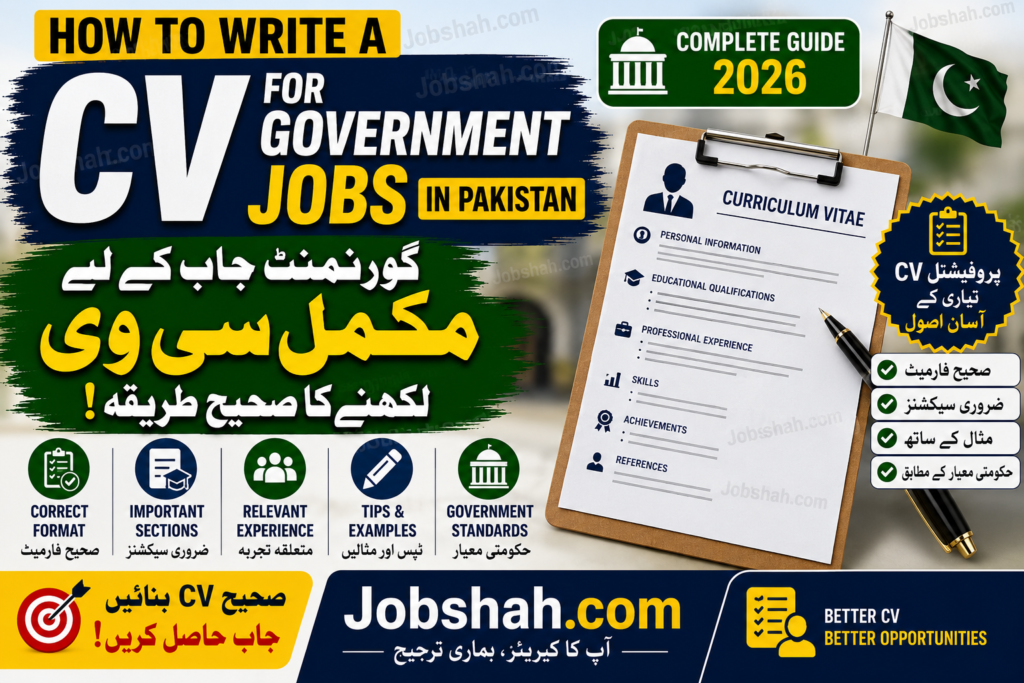
- How to Write a CV for Government Jobs in Pakistan – A Complete Guide

I am a digital content writer and web publishing enthusiast specializing in jobs and career information in Pakistan. I research and publish accurate, useful, and easy-to-understand job updates to help job seekers find the right opportunities.