
Okay so you just saw a government job advertisement. It says “BPS-17” in the eligibility section and you are sitting there wondering — what does that actually mean? How much will I actually take home every month? Is it worth it?
You are not alone. This is one of the most searched questions in Pakistan every single day — and most articles either give you only the basic pay number (which is misleading) or bury you in technical jargon you did not ask for.
So let me explain everything in plain language. What BPS actually is, what all 22 grades mean, what the revised 2026 salary chart looks like, what allowances get added on top of basic pay, and what your actual gross monthly salary would be at each grade.
What Is BPS — Basic Pay Scale?
BPS stands for Basic Pay Scale. It is the standardized salary system used by the Government of Pakistan to pay all civil servants — whether federal, provincial, or local government employees.
The BPS system was introduced to bring uniformity and transparency to government pay. Instead of every department setting its own salary, the government created 22 grades — from BPS-1 at the bottom to BPS-22 at the top. Every government job falls somewhere in this range.
When a job advertisement says “BPS-17,” it means the post carries Grade-17 of the Basic Pay Scale system. Your salary, annual increment, pension entitlement, and service terms are all determined by which BPS grade your post sits in.
The important thing to understand right away: the basic pay number you see in the advertisement is NOT what you take home. Your actual gross salary is significantly higher once allowances are added on top. I will explain exactly how much higher in a bit.
The Big 2026 Update — What Changed This Year
This is important because a lot of salary information online is outdated. The Government of Pakistan issued Revised Basic Pay Scales 2026 (RBPS-2026) through a Ministry of Finance Office Memorandum dated 21 July 2026, effective from 1 July 2026.
Here is what happened:
What changed:
- The Ad-hoc Relief Allowance 2022 (15%) and Ad-hoc Relief Allowance 2025 (10%) were permanently merged into basic pay — meaning every grade’s basic pay increased by approximately 20-25% as a result
- A new 7% Ad-hoc Relief Allowance 2026 was added on top of the new revised basic pay
- Conveyance Allowance was increased by 50% for all BPS-1 to BPS-22 employees
- A 15% Disparity Reduction Allowance (DRA) was introduced for eligible employee categories
What stayed the same:
- Annual increments continue on 1 December every year
- Point-to-point pay fixation — existing employees kept the same increment stage, just at higher amounts
- BPS-2026 replaces BPS-2022 as the standard structure
In simple terms: if you were a government employee before July 2026, you got a meaningful salary increase. If you are joining now, you are starting at the new higher rates.
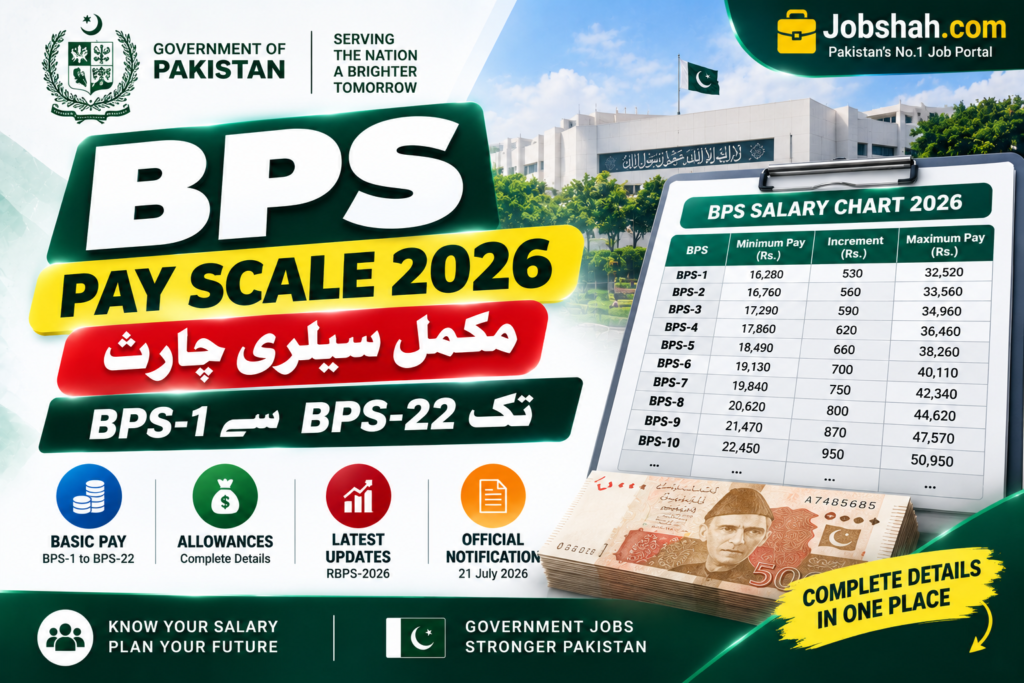
BPS Pay Scale 2026 — Complete Salary Chart (BPS-1 to BPS-22)
This is the official revised Basic Pay Scale 2026 chart. The Minimum Pay is what you start at when you first join. Annual Increment is the fixed amount added to your basic pay every December. The Maximum Pay is the ceiling you reach after completing all stages in that grade.
| BPS Grade | Minimum Basic Pay | Annual Increment | Maximum Basic Pay | Approximate Stages |
|---|---|---|---|---|
| BPS-1 | Rs. 16,280 | Rs. 530 | Rs. 32,520 | 30 |
| BPS-2 | Rs. 16,760 | Rs. 560 | Rs. 33,560 | 30 |
| BPS-3 | Rs. 17,290 | Rs. 590 | Rs. 34,960 | 30 |
| BPS-4 | Rs. 17,860 | Rs. 620 | Rs. 36,460 | 30 |
| BPS-5 | Rs. 18,490 | Rs. 660 | Rs. 38,260 | 30 |
| BPS-6 | Rs. 19,130 | Rs. 700 | Rs. 40,110 | 30 |
| BPS-7 | Rs. 19,840 | Rs. 750 | Rs. 42,340 | 30 |
| BPS-8 | Rs. 20,620 | Rs. 800 | Rs. 44,620 | 30 |
| BPS-9 | Rs. 21,470 | Rs. 870 | Rs. 47,570 | 30 |
| BPS-10 | Rs. 22,450 | Rs. 950 | Rs. 50,950 | 30 |
| BPS-11 | Rs. 23,530 | Rs. 1,020 | Rs. 54,130 | 30 |
| BPS-12 | Rs. 24,690 | Rs. 1,110 | Rs. 57,990 | 30 |
| BPS-13 | Rs. 25,960 | Rs. 1,200 | Rs. 61,960 | 30 |
| BPS-14 | Rs. 27,370 | Rs. 1,300 | Rs. 66,370 | 30 |
| BPS-15 | Rs. 28,970 | Rs. 1,410 | Rs. 71,270 | 30 |
| BPS-16 | Rs. 30,740 | Rs. 1,530 | Rs. 76,640 | 30 |
| BPS-17 | Rs. 54,140 | Rs. 2,320 | Rs. 123,740 | 30 |
| BPS-18 | Rs. 68,750 | Rs. 2,940 | Rs. 156,950 | 30 |
| BPS-19 | Rs. 87,290 | Rs. 3,730 | Rs. 199,190 | 30 |
| BPS-20 | Rs. 110,790 | Rs. 4,740 | Rs. 252,990 | 30 |
| BPS-21 | Rs. 128,920 | Rs. 5,520 | Rs. 294,520 | 30 |
| BPS-22 | Rs. 146,770 | Rs. 6,290 | Rs. 335,470 | 30 |
Source: Ministry of Finance Office Memorandum No. F.1(2)IMP/2026 dated 21 July 2026 — Revised Basic Pay Scales 2026, effective 1 July 2026.
Important note: These figures show basic pay only. Your actual take-home salary is significantly higher due to allowances. Keep reading.
The Jump Between BPS-16 and BPS-17 — Why It Matters So Much
You may have noticed something in the chart above. There is a huge gap between BPS-16 (minimum Rs. 30,740) and BPS-17 (minimum Rs. 54,140). That jump of nearly Rs. 24,000 in basic pay is not a mistake.
BPS-16 is the highest non-officer grade. Positions here include Inspectors, Senior Clerks, and Superintendents. These are generally recruited through departmental tests or promotions.
BPS-17 is the first officer grade — the entry point into Pakistan’s civil officer cadre. Positions here include Assistant Directors, Sub-Divisional Officers, Police Sub-Inspectors (gazetted), College Lecturers, and Medical Officers. BPS-17 officers are generally selected through FPSC, PPSC, SPSC, or BPSC competitive examinations or CSS/PMS.
That salary gap reflects the difference in status, responsibility, and career trajectory. A BPS-17 officer has a fundamentally different career path than a BPS-16 employee — faster promotion prospects, gazetted status, and access to senior management roles over time.
This is why everyone wants BPS-17+ jobs and why those exams are so competitive.
What Allowances Are Added on Top of Basic Pay?
Here is the part that actually matters for understanding your real salary.
Basic pay is just the foundation. The government adds multiple allowances on top. Here are the main ones every government employee receives in 2026:
House Rent Allowance (HRA)
This is the biggest allowance. The rate depends on where you are posted:
- A-Category cities (Islamabad, Lahore, Karachi, Peshawar, Quetta): 45% of basic pay
- B-Category cities (other major cities): 30% of basic pay
- Other areas / small cities: 15% of basic pay
Medical Allowance
A fixed monthly amount for healthcare. Rates vary by BPS grade but typically range from Rs. 3,000 to Rs. 10,000 per month as of 2026.
Conveyance Allowance
A flat monthly amount for transportation. Increased by 50% in 2026 as part of the budget revision. This is a fixed rupee amount per grade band, not percentage-based.
Ad-hoc Relief Allowance 2026
7% of running basic pay under BPS-2026 — effective from 1 July 2026 for all BPS-1 to BPS-22 employees.
Disparity Reduction Allowance (DRA) 2026
15% — but only for specific eligible employee categories as notified by the Finance Division. Not every employee gets this.
Other Allowances (Depending on Post and Department)
- Utility Allowance — for paying electricity and gas bills
- Special Pay — for certain technical or sensitive posts
- Orderly Allowance — for senior officers
- Washing Allowance — for certain uniformed services
Real Salary Examples — What You Actually Take Home
Let me give you practical examples so the numbers make sense.
Example 1: LDC / UDC / Junior Clerk — BPS-11
Basic Pay (minimum): Rs. 23,530 HRA (45% in Islamabad): Rs. 10,589 Medical Allowance: Rs. 4,000 (approx.) Conveyance Allowance: Rs. 3,000 (approx.) ARA 2026 (7%): Rs. 1,647
Approximate Gross Monthly: Rs. 42,000 – 50,000
Example 2: Assistant / UDC — BPS-14
Basic Pay (minimum): Rs. 27,370 HRA (45% in Lahore): Rs. 12,316 Medical Allowance: Rs. 5,000 (approx.) Conveyance Allowance: Rs. 3,500 (approx.) ARA 2026 (7%): Rs. 1,916
Approximate Gross Monthly: Rs. 52,000 – 62,000
Example 3: Assistant Director / Lecturer — BPS-17
Basic Pay (minimum): Rs. 54,140 HRA (45% in Karachi): Rs. 24,363 Medical Allowance: Rs. 8,000 (approx.) Conveyance Allowance: Rs. 5,000 (approx.) ARA 2026 (7%): Rs. 3,790
Approximate Gross Monthly: Rs. 95,000 – 120,000
Example 4: Deputy Secretary / Senior Officer — BPS-20
Basic Pay (minimum): Rs. 110,790 HRA (45% in Islamabad): Rs. 49,855 Medical Allowance: Rs. 10,000 (approx.) Conveyance Allowance: Rs. 8,000 (approx.) ARA 2026 (7%): Rs. 7,755
Approximate Gross Monthly: Rs. 190,000 – 250,000
Example 5: Federal Secretary — BPS-22
Basic Pay (minimum): Rs. 146,770 HRA (45%): Rs. 66,047 Allowances: Rs. 30,000+ (various senior officer allowances) ARA 2026 (7%): Rs. 10,274
Approximate Gross Monthly: Rs. 280,000 – 400,000+
These are approximations. Your exact salary depends on your current increment stage, posting city, departmental allowances, and deductions.
Also Check > How to Write a Professional Resume With No Experience in Pakistan
Which Posts Sit in Which BPS Grade?
This is the question most job seekers actually want answered. Here is a quick guide:
| BPS Grade | Typical Posts | Career Entry |
|---|---|---|
| BPS-1 | Naib Qasid, Peon, Sweeper, Helper | Middle / Primary pass |
| BPS-2 to 4 | Mali, Chowkidar, Sanitary Worker | Primary to Middle |
| BPS-5 | Driver (LTV), Dispatch Rider | Matric + licence |
| BPS-7 | Cook, Dak Runner, Office Boy | Matric |
| BPS-9 | LDC (Lower Division Clerk), Junior Clerk | Matric to Intermediate |
| BPS-11 | UDC (Upper Division Clerk), Junior Accountant | Intermediate to Bachelor |
| BPS-14 | Stenotypist, Data Entry Operator | Intermediate + typing skills |
| BPS-15 | Head Clerk, Senior Assistant | Bachelor’s degree |
| BPS-16 | Inspector, Sub-Inspector (Non-gazetted), Senior Accountant | Bachelor’s |
| BPS-17 | Assistant Director, Lecturer, Medical Officer, Magistrate, DSP (Gazetted) | Bachelor’s / Master’s — FPSC/PPSC |
| BPS-18 | Deputy Director, Assistant Commissioner, Associate Professor | Master’s / experience |
| BPS-19 | Director, Commissioner, Professor | Senior promotion |
| BPS-20 | Senior Director, Deputy Secretary | Senior promotion |
| BPS-21 | Additional Secretary, IGP | Very senior promotion |
| BPS-22 | Federal Secretary, Chief Secretary, Chairman | Highest career point |
Annual Increment — How Your Salary Grows Each Year
Every year on 1 December, a government employee receives an annual increment — a fixed amount added to their basic pay. This continues until they reach the maximum of their grade.
So if you join at BPS-17 with a minimum basic pay of Rs. 54,140 and the annual increment is Rs. 2,320, after one year your basic pay becomes Rs. 56,460. After five years it is Rs. 65,740. After ten years it is Rs. 77,340 — and all your allowances (especially HRA) increase proportionally since they are calculated as a percentage of basic pay.
This compounding effect is one of the genuine financial advantages of government employment. Your salary grows automatically every December without needing a promotion or a salary negotiation.
To become eligible for the annual increment, you need at least six months of continuous service in the calendar year.
Pension — The Long-Term Benefit Nobody Talks About Enough
One of the biggest reasons government jobs are valued in Pakistan is lifetime pension after retirement.
After completing qualifying service (generally 10 or more years), government employees receive a monthly pension for life after retirement. For BPS-17 officers, this pension can be Rs. 30,000 to Rs. 60,000+ per month depending on service length and last drawn basic pay.
The government also increased pensions by 7% effective 1 July 2026 as part of the budget package.
When you are comparing a government salary to a private sector offer, always factor in the pension. A private sector job paying Rs. 150,000 per month with no pension is not necessarily better than a government BPS-17 job paying Rs. 110,000 gross with a lifetime pension waiting at retirement.
Federal vs Provincial BPS — Is There a Difference?
Yes, there is — but not as much as you might think.
Federal BPS (for federal government employees) follows the Ministry of Finance pay scale exactly as shown in the chart above.
Provincial pay scales — Punjab (PPS), Sindh (SPS), KPK, and Balochistan — have their own pay scale structures that broadly mirror federal BPS but include province-specific allowances:
- Punjab: Integrated Allowance, Special Relief Allowance, and Senior Post Allowance are added — making Punjab government salaries slightly different from federal
- Sindh: Similar structure with Sindh-specific additions
- KPK and Balochistan: Both follow broadly similar structures with some local variations
In practice, total gross salaries across federal and provincial grades tend to be in a similar range — the base structure is the same even when specific allowances differ.
What Is the Difference Between BPS-16 and BPS-17?
This deserves its own section because so many people search this specifically.
| Feature | BPS-16 | BPS-17 |
|---|---|---|
| Category | Non-Gazetted Officer | Gazetted Officer |
| Minimum Basic Pay 2026 | Rs. 30,740 | Rs. 54,140 |
| Typical Posts | Inspector, Senior Clerk, Superintendent | Assistant Director, Lecturer, DSP |
| Entry Route | Departmental test / promotion | FPSC / PPSC competitive exam / CSS |
| Promotion Prospects | Slower, competitive | Faster officer cadre path |
| Status | Non-gazetted | Gazetted — can attest documents |
| Pension | Yes | Yes |
The jump is significant both in terms of pay and career trajectory. BPS-17 is the entry point into officer cadre — which is why government competitive exams like FPSC, PPSC, CSS, and PMS are so sought after.
Government Salary vs Private Sector — The Real Comparison
A lot of fresh graduates struggle with this decision and it deserves an honest answer.
Government is better if:
- You value job security — you cannot be laid off without a formal inquiry process
- You want a guaranteed pension for life after retirement
- Medical coverage for yourself and your family matters to you
- You want structured working hours (most departments: 9 AM to 5 PM)
- You prefer a predictable salary that grows automatically every December
- You want to serve in a role that contributes to public services
Private sector is better if:
- You want higher starting salary at equivalent education level
- Performance-based bonuses and rapid promotion matter more to you
- You are in a technical field (IT, engineering, finance) where private pays significantly more
- You want flexibility in how you work and who you work for
The honest truth for 2026: BPS-17 officers in Islamabad with all allowances earn approximately Rs. 95,000 to Rs. 120,000 gross per month. A fresh software engineer in Lahore can earn Rs. 100,000 to Rs. 180,000. For IT and tech, private sector generally wins on starting salary. For law, administration, education, and general management, government service is often financially competitive once pension and benefits are factored in.
Frequently Asked Questions
1. What is BPS salary in Pakistan for 2026?
BPS stands for Basic Pay Scale. Under the revised BPS-2026 structure effective 1 July 2026, salaries range from Rs. 16,280 minimum (BPS-1) to Rs. 146,770 minimum (BPS-22) in basic pay. Your actual gross salary is higher — typically 50-80% above basic pay once HRA, Medical, Conveyance, and other allowances are added.
2. What is the salary of BPS-17 in Pakistan 2026?
BPS-17 minimum basic pay is Rs. 54,140 under the revised 2026 scales. With all allowances in an A-category city (Islamabad, Lahore, Karachi), the gross monthly salary is approximately Rs. 95,000 to Rs. 120,000.
3. When did the BPS 2026 salary revision take effect?
The revised Basic Pay Scales 2026 (RBPS-2026) were officially notified by the Ministry of Finance on 21 July 2026 and are effective from 1 July 2026.
4. What is the difference between basic pay and gross salary?
Basic pay is the amount listed in your BPS grade. Gross salary includes basic pay plus House Rent Allowance (45% of basic in major cities), Medical Allowance, Conveyance Allowance, Ad-hoc Relief Allowance, and other applicable allowances. Gross salary is typically 50-80% higher than basic pay.
5. When is the annual increment given to government employees?
Annual increments are awarded on 1 December every year. To qualify, an employee must have at least six months of continuous service in that calendar year.
6. What happened to the ad-hoc relief allowances in 2026?
The Ad-hoc Relief Allowance 2022 and Ad-hoc Relief Allowance 2025 were permanently merged into basic pay under the RBPS-2026 revision. They no longer exist as separate allowances from 1 July 2026. A new 7% Ad-hoc Relief Allowance 2026 was introduced separately.
- National Bank of Pakistan Jobs 2026 – NBP Latest Vacancies, Salary and How to Apply
- Pakistan Railways Jobs 2026 – Latest Vacancies, How to Apply and Complete Guide

- Bank of Punjab Jobs 2026 – Latest BOP Vacancies, How to Apply and Complete Guide

- NADRA Jobs 2026 – Latest Vacancies, How to Apply and Complete Guide

- Millat Tractors Internship 2026 – How to Apply, Departments, Stipend and Everything You Need to Know


I am a digital content writer and web publishing enthusiast specializing in jobs and career information in Pakistan. I research and publish accurate, useful, and easy-to-understand job updates to help job seekers find the right opportunities.
Pingback: 10 Interview Mistakes You Are Making Right Now – And How to Fix Them - jobshah.com