
Let me be real with you. Most people who fail interviews do not fail because they were not smart enough or not qualified enough. They fail because of avoidable mistakes — things they did not even realize they were doing wrong.
I have seen people with excellent CVs, strong test scores, and genuinely relevant experience walk out of interview rooms without a job offer. And in almost every case, it came down to one or more of the mistakes on this list.
The good news? Every single mistake here is fixable. You just have to know what to look for.
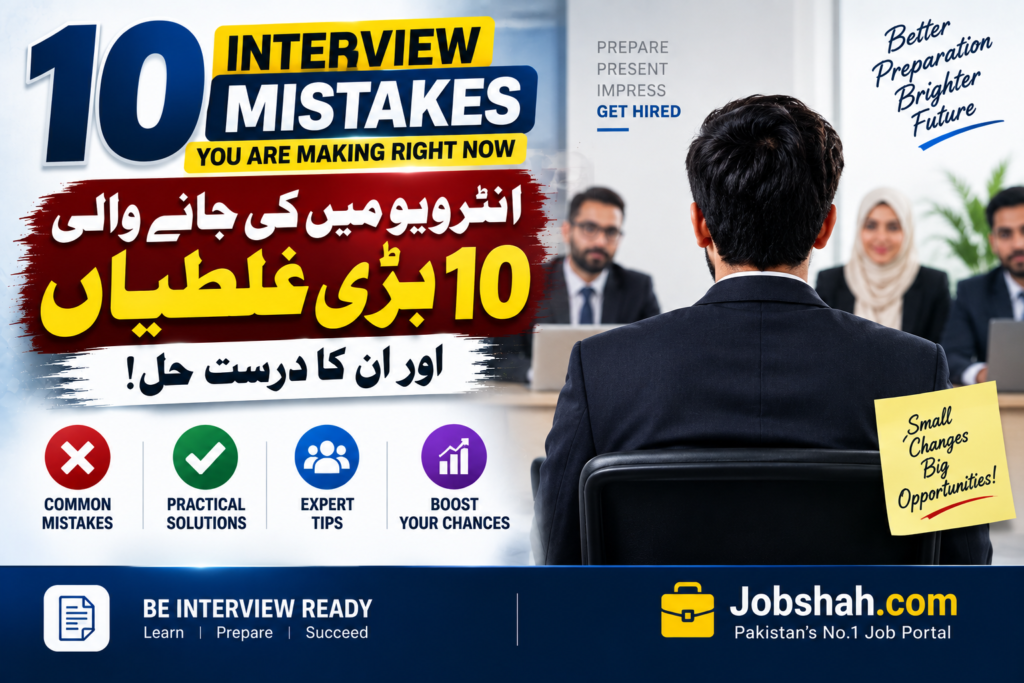
Mistake 1 — You Did Not Research the Organization
This is the most common interview killer and the easiest one to fix.
Almost every interview — government or private sector — includes a question like “What do you know about our organization?” or “Why do you want to work here?” If your answer is vague, generic, or worse, if you look blank for three seconds before answering, the panel knows immediately that you just applied everywhere and hoped for the best.
A panel that spends weeks reviewing applications and shortlisting candidates does not want to hear “I am very interested in your esteemed organization.” That tells them nothing.
What to do instead: Spend one hour before the interview on the organization’s official website. Know:
- When it was founded and by whom
- What its core function or mandate is
- Which ministry or group it falls under
- Any recent news, projects, or milestones
- The approximate number of employees or offices
Walk in able to say something specific. “PERA was established to enforce consumer protection laws and regulatory compliance across Punjab’s business sector — I know the authority has been expanding its enforcement operations in 2026 and I want to contribute to that.” That kind of answer tells the panel you are serious.
Mistake 2 — You Arrived Late
In Pakistan’s interview culture — especially for government jobs — arriving late is almost unrecoverable. It signals disrespect for the panel’s time before you have even said a word.
Panels take note of who arrives on time and who does not. In competitive shortlists where multiple candidates are equally qualified, punctuality becomes a differentiator.
What to do instead: Plan your route the night before. Check how long it actually takes to get there — not in normal conditions, but accounting for traffic at that time of morning. Leave the house with enough margin to arrive 20 to 30 minutes early. Sit in the waiting area, review your notes, compose yourself. Arriving early costs you nothing. Arriving late can cost you the job.
Mistake 3 — You Had No Answer for “Tell Me About Yourself”
This sounds like a warm-up question. It is not. It is the question where most candidates immediately reveal whether they prepared or just showed up.
The two most common failure modes here are:
- Going way too long and rambling through your entire life story from childhood
- Saying something so generic and forgettable that the panel has already moved on before you finish
What to do instead: Prepare a 60 to 90 second answer. It has three parts:
- Your most relevant qualification and where you got it
- One or two specific skills or experiences that directly match this role
- Why you want this specific job at this specific organization
Rehearse it out loud until it feels natural. Not memorized — natural. There is a difference. Memorized sounds robotic. Natural sounds confident.
Also Read > BPS Pay Scale 2026 Pakistan – Complete Salary Chart BPS-1 to BPS-22
Mistake 4 — You Badmouthed a Previous Employer
When a panel asks “Why did you leave your last job?” or “Tell us about a difficult experience at your previous workplace,” candidates sometimes use it as an opportunity to vent about how terrible their boss was or how unfair the environment was.
This is a trap. The moment you start criticizing a previous employer in an interview, the panel’s internal reaction is: “This person will say the same thing about us one day.” It makes you look difficult, disloyal, and unprofessional — regardless of whether your grievance was legitimate.
What to do instead: Keep it neutral and forward-looking. “I learned a great deal in that role but I felt I had reached the limit of my growth there. I am looking for an environment where I can take on more responsibility and develop in a structured way.” That is a clean, professional answer that does not create any red flags.
Mistake 5 — Your Body Language Was Undermining Everything You Said
You can say all the right words and still fail an interview because of how you were sitting, where you were looking, or what your hands were doing.
Common body language mistakes in Pakistani interviews:
- Slouching in the chair — signals low energy and low confidence
- Looking down at your hands instead of at the panel — signals nervousness and evasiveness
- Crossing your arms — signals defensiveness
- Fidgeting with a pen, phone, or water bottle — signals anxiety
- Nodding too aggressively — looks performed and insincere
What to do instead: Sit upright but comfortably — not stiffly, not slouched. Keep your hands rested on the table or in your lap. Make eye contact with each panel member as you answer — not staring, but natural eye contact that moves around the room. Slow down your speaking pace. When people are nervous they speak faster. Consciously slow down. It projects calm and confidence even when you do not feel calm inside.
Mistake 6 — You Could Not Answer Questions About Your Own CV
This one is embarrassing but it happens more often than you would think. A panel member asks about something specific on your CV — a project you listed, a date, a responsibility — and you fumble because you cannot remember the details or because the information on your CV was stretched beyond the truth.
When you cannot answer questions about your own CV, it raises an immediate red flag. Either the information is inaccurate or you are genuinely disorganized. Neither impression is good.
What to do instead: Read your CV thoroughly the night before every interview. Know every date, every role, every project you listed. Be able to expand on any bullet point with a real example. If anything on your CV was even slightly exaggerated, be prepared to answer for it — or better yet, do not exaggerate in the first place.
Mistake 7 — You Said “No” When Asked If You Have Questions
When the panel says “Do you have any questions for us?” at the end of the interview, almost every candidate in Pakistan says one of two things: “No, I have no questions” or “I am completely satisfied.”
Both of these are mistakes. Not asking questions signals one of two things — either you are not genuinely interested in the role, or you are so relieved the interview is ending that you just want to leave. Neither impression is the one you want to leave on a panel.
What to do instead: Prepare two or three questions before you go in. Good questions to ask:
- “What does the first three months in this role typically look like?”
- “What are the key challenges this department is currently working to address?”
- “What do the strongest performers in this team have in common?”
These questions show curiosity, professionalism, and genuine interest. They also extend the conversation on your terms, which is a small but real advantage.
Do not ask about salary, leave entitlement, or working hours in the first interview unless the panel brings it up.
Mistake 8 — You Gave Vague Answers With No Examples
“I am a good team player.” “I have strong communication skills.” “I work well under pressure.”
These are things everyone says. They mean nothing without a specific example to back them up. Panels hear these phrases dozens of times in every recruitment cycle. When you say them without evidence, they slide right off.
What to do instead: Use real examples. Every claim about a skill or quality should be followed by a brief, specific story. Use the simple structure of: Situation → Action → Result.
Instead of “I work well under pressure,” say: “In my previous role, two team members were absent the week before a major submission deadline. I reorganized the workload, stayed late for three evenings, communicated proactively with my supervisor about the adjusted timeline, and we delivered on time. That situation actually taught me a lot about prioritization under real pressure.”
That answer is memorable. It is specific. It is believable. That is what panels are looking for.
Mistake 9 — You Were Not Dressed Appropriately
First impressions in Pakistan’s professional and government interview culture are heavily influenced by how you are presented. An interviewer makes a subconscious judgment about your professionalism, maturity, and seriousness within the first thirty seconds of meeting you — before you have said a word.
Common dressing mistakes:
- Casual clothes — jeans and a t-shirt to a formal government interview
- Bright or distracting colours — loud patterns, bright reds or yellows
- Unclean or unpolished shoes — people notice this more than you think
- Excessive jewellery or strong perfume or cologne
- Clothes that are visibly wrinkled or not properly ironed
What to do instead: The rule is simple — dress one level more formally than you think is required. For men: a plain dark shalwar kameez or a formal suit and tie, clean and pressed, with polished shoes. For women: a formal shalwar kameez or professional outfit in a conservative, plain colour with minimal accessories. Prepare your clothes the night before — not on the morning of the interview when you are already anxious.
Mistake 10 — You Lied or Exaggerated — And Got Caught
This is the most serious mistake on this list. And it happens more than most candidates realize, because many people think small exaggerations are safe.
“I have two years of experience” when it was fourteen months. “I managed a team of ten” when you supervised two junior colleagues occasionally. “I am fluent in English” when you struggle in a conversation.
Panels are experienced professionals. They follow up on vague claims. They ask probing questions. They sometimes contact previous employers. When an inconsistency is discovered — during the interview, during verification, or after joining — the consequences are severe. In government recruitment, being caught providing false information can result in permanent disqualification and blacklisting.
What to do instead: Be honest. If your experience is fourteen months, describe it accurately and explain what you learned and what you contributed. Genuine, well-described experience at a shorter duration is far more impressive than inflated claims that collapse under a single follow-up question.
If you have a weakness or a gap, own it briefly and redirect to what you did with that time or what you learned from that period. Honesty combined with self-awareness is a genuinely attractive quality in any candidate.
The One Thing All These Mistakes Have in Common
Every mistake on this list comes down to one thing: lack of preparation.
Candidates who research the organization, rehearse their answers out loud, review their own CV, prepare questions to ask, iron their clothes the night before, and plan their route in advance — these candidates walk into interview rooms with a completely different energy than candidates who prepared nothing.
Preparation does not eliminate nerves. It channels them productively. When you know your material, nerves turn into alertness. When you do not, they turn into panic.
The interview is not the test. The preparation is the test. The interview is just where you show what you have already done.
Frequently Asked Questions
1. What is the most common interview mistake in Pakistan?
Not researching the organization before the interview. When a panel asks “What do you know about us?” and the candidate has no answer, it immediately signals lack of genuine interest and poor preparation.
2. What should I not say in a job interview?
Never badmouth a previous employer or colleague. Avoid vague claims without specific examples. Do not lie about experience, qualifications, or skills. Avoid asking about salary or leave in the first interview unless the panel raises it.
3. How do I handle being nervous in an interview?
Slow your speaking pace consciously — nerves make people speak faster. Sit upright but naturally. Make eye contact with panel members. Take a brief pause before answering difficult questions instead of rushing. Preparation is the most effective cure for interview nerves.
4. Should I ask questions at the end of an interview?
Always. Prepare two or three thoughtful questions before you go in. Good ones include asking about the first 90 days in the role, key challenges in the department, or what successful people in the team have in common. Never leave without asking at least one question.
5. How early should I arrive for a job interview?
Arrive 20 to 30 minutes before your scheduled time. This gives you time to find the right office, compose yourself, and review your notes. Arriving late — even by five minutes — creates a very difficult first impression that is hard to recover from.
6. What is the biggest mistake fresh graduates make in interviews?
Giving generic answers without specific examples. Saying “I am a team player” or “I work well under pressure” without a real story to back it up tells the panel nothing. Every claim about a skill should be followed by a brief, specific example from your academic or personal experience.
Related Blogs
- How to Apply for Government Job After Graduation in Pakistan – Step by Step Guide
- 10 Interview Mistakes You Are Making Right Now – And How to Fix Them
- BPS Pay Scale 2026 Pakistan – Complete Salary Chart BPS-1 to BPS-22
- How to Write a Professional Resume With No Experience in Pakistan
- How to Pass Government Job Interview in Pakistan – 10 Real Questions and Answers
- How to Write a CV for Government Jobs in Pakistan – A Complete Guide
I am a digital content writer and web publishing enthusiast specializing in jobs and career information in Pakistan. I research and publish accurate, useful, and easy-to-understand job updates to help job seekers find the right opportunities.