You walk into the room. Three, five, maybe seven people are sitting at a long table, papers in front of them, all looking at you. Someone says, “Please sit.” Your heart is racing, your mouth is dry, and the one thing you are afraid of is that question. The tricky one. The one you did not prepare for.
I have good news: tough questions in a panel interview are not meant to destroy you. They are meant to see how you think, how calm you stay, and whether you are honest. And all of that can be practised. So let me walk you through it step by step, like I would for a friend the night before the interview.
What Is a Panel Interview?
A panel interview is one where several people interview you at the same time. In Pakistan you will meet it in:
| Where You Will See It | Examples |
|---|---|
| Public service commissions and selection boards | FPSC, PPSC, KPPSC, SPSC and similar bodies |
| Banks and large organizations | Final-round interviews for officer and management posts |
| Universities and schools | Lecturer and teaching posts |
| Multinationals and corporates | Later rounds for managerial roles |
Reports about the CSS viva describe a panel of around 5 to 7 members, led by a chairperson, with each member asking questions from their own area. Whatever the setup, the basics are the same.
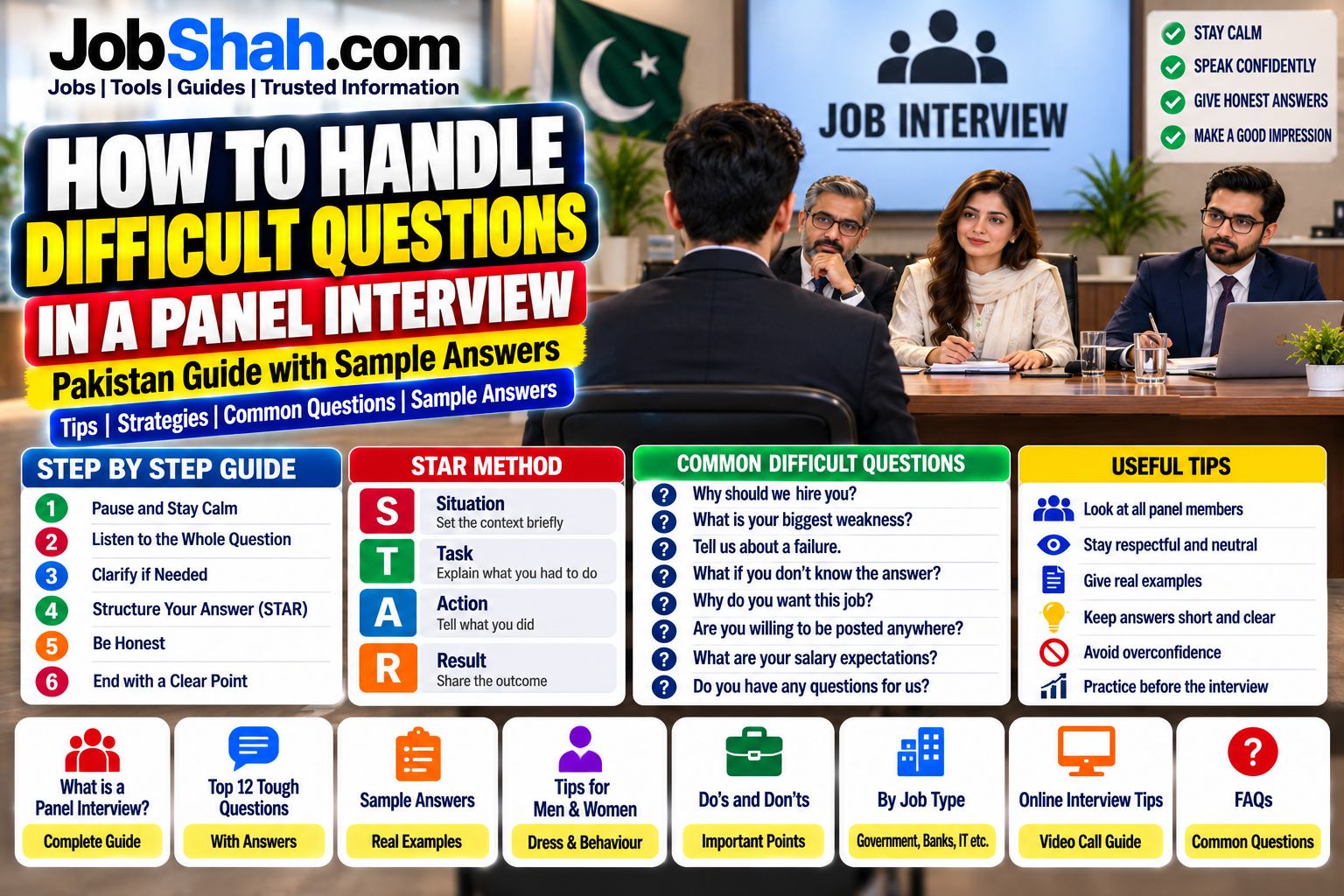
The 6-Step Method for Any Difficult Question
When a hard question lands, do this:
- Pause. Take a breath and a two-second silence. A calm pause looks confident, not weak.
- Listen to the whole question. Many candidates start answering too early and miss the point.
- Clarify if needed. Say, “Sir, may I confirm that you are asking about…?”
- Structure your answer. Use a short frame (see below) so you do not ramble.
- Be honest. Never bluff. Experienced panel members can tell.
- End cleanly. Finish your answer, stop talking, and wait. Do not fill the silence.
Use a Simple Structure: STAR
For questions about your past (“Tell us about a time when…”), the STAR method keeps you focused:
| Letter | Meaning | Example |
|---|---|---|
| S | Situation | “During my final-year project, our team lost a member two weeks before submission.” |
| T | Task | “I had to make sure we still finished on time.” |
| A | Action | “I divided the remaining work, took the extra part myself and stayed late to finish testing.” |
| R | Result | “We submitted on time and got an A grade.” |
For opinion questions, try point, reason, example: give your view, one reason, one short example.
How to Handle the Panel Itself
| Situation | What to Do |
|---|---|
| Many people, one question | Look at the person who asked, then move your eyes to the others as you speak, and return to the asker for your last point |
| Two people ask at once | Pick one, answer fully, then say “And to your question, sir…” |
| A quiet panel member | Include them with eye contact. Do not ignore them because they speak less |
| A member looks stern or bored | Do not let it shake you. Many panelists keep a straight face on purpose |
| A member interrupts | Stop, listen, answer the new point calmly, and then offer to complete your earlier point if needed |
| You freeze | Say, “Sir, may I have a moment to think?” Then answer |
Greet everyone when you enter, smile and say “Assalam o Alaikum” or “Good morning”. If names are given, note them.
The 12 Toughest Questions and How to Answer Them
| Question | What They Really Want to Know | How to Answer |
|---|---|---|
| “Tell us about yourself.” | Can you speak clearly and stay relevant? | 60 to 90 seconds: education, one or two key experiences, why this job. Do not recite your whole life. |
| “Why do you want this job?” | Do you understand the post, and are you serious? | Link your skills to the role. Mention what you read about the organization. |
| “Why should we hire you?” | Can you prove value without boasting? | Give two strengths with a real example, then say you want to learn and contribute. |
| “What is your biggest weakness?” | Are you self-aware and improving? | Pick a real, minor weakness and show what you are doing about it. |
| “Tell us about a failure.” | Do you take responsibility? | Use STAR, own the mistake and finish with what you learned. |
| “What if you do not know the answer?” | Are you honest? | Say what you do know and admit what you do not. Never invent facts. |
| “What are your salary expectations?” | Are you realistic? | Say you expect a fair package as per the organization’s scale or market, and that learning matters too. |
| “Why is there a gap in your education or career?” | Are you honest and moving forward? | Give a short, truthful reason and what you did during that time. |
| “Are you willing to be posted anywhere?” | Are you flexible? | If it is true, say yes. If not, be honest about limits without sounding negative. |
| “What is your opinion on [political or controversial issue]?” | Can you stay balanced and respectful? | Stay factual and neutral. Present both sides, then give a careful view without attacking anyone. |
| “Do you know anyone in this department?” | Are you honest and merit-minded? | Answer truthfully and briefly. Do not drop names or suggest influence. |
| “Do you have any questions for us?” | Are you interested? | Ask one or two thoughtful questions about training, the role or the team. Not about leave or salary first. |
Three Sample Answers You Can Adapt
Weakness: “Sir, I used to take on too many tasks myself because I was afraid of delegating. During my internship, my supervisor pointed out that this slowed us down. Since then I make a short task list and ask teammates to handle parts of the work. I am still improving, but our last project finished a day early.”
Failure: “In my second year I missed a presentation deadline because I underestimated the work. I told my teacher immediately, took responsibility, and submitted it the next day with a lower grade. Since then I plan tasks backwards from the deadline and finish a draft two days early.”
When you do not know the answer: “Sir, I am not fully sure about that specific detail, and I would not like to guess. What I do know is that [one correct related fact]. I will certainly look it up after this interview.”
Government Panels: A Few Extra Points
For commission and selection board interviews:
- Prepare your background. Be ready to explain your degree, subjects, projects and why you chose public service.
- Prepare current affairs and Pakistan basics. Panels often ask general knowledge and current affairs. Practise with our FPSC test preparation MCQs 2026.
- Answer in the language you are asked in. The KPPSC’s own interview tips recommend this, along with giving positive answers to negative-based questions, listening carefully and keeping a smile.
- Stay calm if challenged. Arguing aggressively with panel members is listed as a mistake in CSS viva guidance. You are being judged on temperament as well as knowledge.
- Check your interview schedule. Commissions such as FPSC publish interview programs on their websites, and schedules can change.
Body Language and Voice
- Sit straight, hands on your lap or on the table, not crossed tight
- Speak slowly and clearly, because nervous people speed up
- Keep answers to roughly one to two minutes
- Use a warm, steady voice, and avoid fillers like “umm” and “like”
- Nod slightly when listening
- Smile at the beginning and end
If you are not sure what to wear, dress one step more formal than the workplace.
Mistakes That Hurt in Panel Interviews
| Mistake | Better Option |
|---|---|
| Talking only to the chairperson | Include everyone with your eyes |
| Bluffing when you do not know | Admit it honestly and share what you do know |
| Memorized, robotic answers | Practise points, not word-for-word scripts |
| Arguing with a panelist | Stay respectful and thank them for the point |
| Speaking negatively about your old boss or university | Stay positive and focus on what you learned |
| Rambling for five minutes | Use STAR or point, reason, example |
| Checking your phone | Switch it off before entering |
Also Check > 10 Interview Mistakes You Are Making Right Now
A 7-Day Practice Plan
| Day | Task |
|---|---|
| Day 1 | Write your 60-second “tell me about yourself” |
| Day 2 | Prepare 5 STAR stories (success, failure, conflict, teamwork, leadership) |
| Day 3 | Practise the 12 tough questions above out loud |
| Day 4 | Record yourself on your phone and watch it |
| Day 5 | Do a mock panel with 2 or 3 friends or family members |
| Day 6 | Revise current affairs and your subject knowledge |
| Day 7 | Rest, prepare documents and clothes, and sleep early |
Before and After the Interview
Read how to pass a government job interview in Pakistan for the full process. Make sure your CV is clear using this CV guide or the resume guide for people with no experience. Keep your documents ready, including a character certificate. Here is what a character certificate is.
If you are unsure which commission to target, read FPSC vs PPSC, and understand pay grades in the BPS pay scale guide.
More Job Guides and Vacancies
| Topic | Link |
|---|---|
| Government job after graduation | How to apply |
| Government jobs | Government Jobs category |
| Bank jobs | Bank Jobs category |
| Private jobs | Private Jobs category |
| Blog and guides | Blog category |
Contact and Help
| Detail | Information |
|---|---|
| Topic | Panel interview preparation |
| Where to Check Your Interview Schedule | The official website of the organization or commission that called you, such as fpsc.gov.pk |
| Job Listings | Jobshah.com |
Final Thoughts
A panel interview is not a trap. It is the same interview with a bigger audience. Pause before you answer, use a simple structure, include everyone with your eyes, stay honest, and never argue. Practise your toughest questions out loud, and you will walk in much calmer than you think.
Bookmark Jobshah.com for new vacancies, interview guides and preparation help.
Frequently Asked Questions
1. What is the best way to answer a difficult question in a panel interview? Pause, listen fully, clarify if needed, answer using a simple structure like STAR, and be honest.
2. Who should I look at when answering? Start with the person who asked, then move your eye contact across the panel, and return to the asker for your final point.
3. What if I do not know the answer? Say honestly what you do know and admit what you do not. Never make up facts.
4. What if two panel members ask questions at the same time? Pick one, answer it fully, then say “And to your question, sir…” for the other.
5. How long should my answers be? Usually one to two minutes, and about 60 to 90 seconds for “Tell us about yourself”.
6. How do I answer questions about controversial topics? Stay factual and neutral, present both sides respectfully and avoid attacking any person or group.
7. Should I answer in English or Urdu? Answer in the language you are asked in. The KPPSC’s own interview tips give this advice.
8. What if a panel member challenges my answer? Stay calm, thank them for the point, explain your reasoning politely and do not argue.